
Whitley County Warrant Phone Search
Whitley County does not publish a searchable active-warrant database on the official county pages reviewed. The official Whitley County Warrants division gives the direct route: call (260) 244-6410, option 1, for warrant questions. The contact panel lists the Sheriff's Department and Jail at 711 N Opportunity Drive, Columbia City, Indiana 46725, and states the warrant channel is available 24 hours.
That phone route matters because warrant status is live. A case docket may show that a warrant was issued, recalled, served, or connected to a missed hearing, but it may not be current enough to prove active status. A person checking Whitley County warrants should ask whether the warrant is active, which court or case issued it, whether bond or appearance instructions exist, and whether an attorney should contact the court or prosecutor before any appearance.
The manifest source for the county warrant division is shown below because it is the official access route for active Whitley County warrant questions.
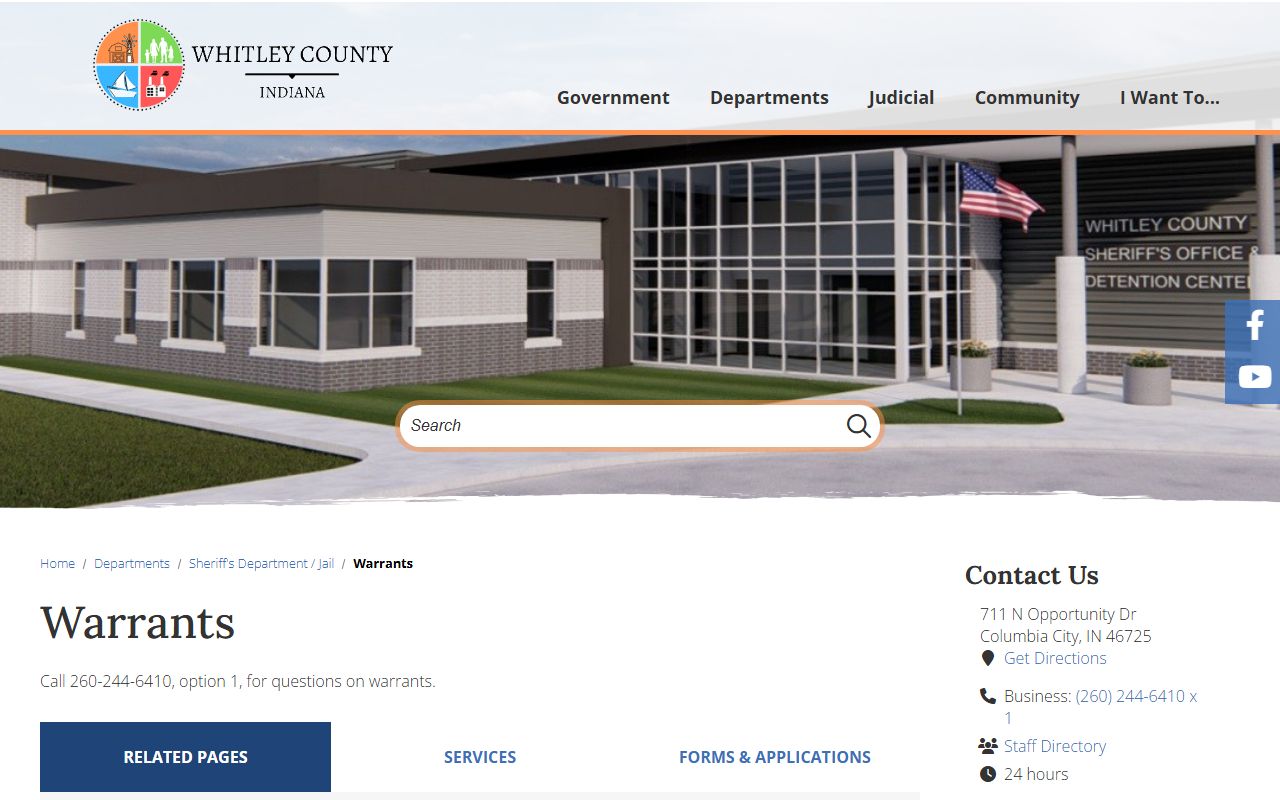
The county warrant page supports a phone-first workflow; it does not provide a public searchable list of names with active warrants.
Whitley County Warrant Court Context
The Clerk of the Circuit and Superior Courts issues arrest warrants, commitments, protective orders, service of process, and writs as part of court-document processing. That means the sheriff may be the live-status office, while the case file may explain the warrant source. A bench warrant can arise from a missed hearing, failure to comply, contempt, probation noncompliance, or unpaid obligation. An arrest warrant can be tied to a new criminal case. A commitment may direct custody after a sentence or court order.
Use Indiana MyCase to look for related Whitley Circuit Court or Whitley Superior Court cases. MyCase can show the case number, court, charges, hearing dates, docket entries, bond entries when public, and disposition lines. The Clerk does not perform criminal or civil searches for the public, but the office provides public-access computers with instructions during regular office hours. Certified copies and case-file copies route through the Clerk or File Management when public access allows them.
| Channel | Best use | Limit |
|---|---|---|
| Sheriff warrant phone | Active warrant questions and live status | No public online name search was found. |
| MyCase | Case context, hearings, charges, docket entries, and court activity | A docket entry is not the same as live warrant confirmation. |
| Clerk office | Public copies, certification, court-file access, and public computers | The Clerk does not perform criminal searches for users. |
| Traffic clerk | Traffic due-date, denial, suspension, and late-fee questions | Traffic failure to comply is not always stated as an arrest warrant. |
Whitley County Warrant Types
Warrant language can cover more than one kind of court or law-enforcement document. The local research supports careful wording because the county warrant page gives a phone number, while the Clerk page confirms court-issued warrants and related documents. Search warrants, bench warrants, arrest warrants, commitments, writs, and protective-order service records do not all have the same public access rules.
- Arrest warrant
- A court order authorizing law enforcement to arrest a person.
- Bench warrant
- A warrant issued by a judge, often after failure to appear or failure to comply.
- Search warrant
- A court order authorizing a search of a place or item, often sealed before or during execution.
- Commitment
- A court document directing custody after sentencing or another court order.
- Protective order service or writ
- A court process served through law enforcement, but not the same as an arrest warrant.
Note: Municipal or town court warrant databases were not located in official Whitley County sources.
Search Whitley County Warrants
The safest official search path starts with the sheriff and then uses the court case record. No public Indiana statewide warrant search for all active warrants was located in official sources, and law-enforcement systems are not the same as public record search tools. Third-party warrant lists can be stale or wrong. Whitley County's official warrant source is the sheriff phone channel.
- Call (260) 244-6410, option 1, for official Whitley County warrant questions.
- Ask whether the warrant is active and whether it came from Whitley Circuit Court, Whitley Superior Court, traffic processing, probation, or another source.
- Search MyCase by name or case number to review the related court file when it is public.
- Call the Clerk at (260) 248-3102 if a public copy, certification, or case-file detail is needed.
- For traffic due-date issues, call the traffic clerk at (260) 248-3103 because the county traffic page focuses on due dates, suspension, late fee, and denial forms.
The county crash-report service is adjacent to law enforcement but separate from warrants. The Whitley County crash reports page charges $8.00 and uses pickup, mail, and BuyCrash channels after reports are processed.
Crash reports show how sheriff records may have separate request channels; warrant status remains a phone-confirmation issue.
Whitley County Warrant Search Fields
Because no official online active-warrant database was found, Whitley County does not have a public warrant search-field table like a roster portal. The working field set is the information a caller or court-record researcher should gather before contacting the sheriff, searching MyCase, or calling the Clerk. More detail helps staff identify the correct person and case, but sensitive data should be shared only with official offices.
| Information | Type | Needed for | Notes |
|---|---|---|---|
| Full name | Text | Sheriff phone and MyCase | Use legal name and any known prior name. |
| Date of birth | Date | Identity match | Useful for common names, but public display may be limited. |
| Case number | Text | MyCase, Clerk, court context | Best way to connect a warrant question to a court file. |
| Court | Selection or office detail | Case routing | Whitley Circuit Court and Whitley Superior Court both handle criminal matters. |
| Hearing or due date | Date | Bench warrant or traffic issue | May explain failure-to-appear or failure-to-comply context. |
| Charge or reason | Text | Case context | Can be confirmed from public court records when available. |
Whitley County Warrant Record Data
A warrant record is not always shown as a stand-alone public document. Some data points may come from sheriff confirmation, some from the court docket, and some from a public copy requested through the Clerk. Search warrants may be sealed or unavailable before execution. Juvenile-related warrant information may be restricted under Indiana juvenile confidentiality rules.
| Field or data point | What it can show |
|---|---|
| Name | The person connected to the warrant, subject to identity confirmation by the sheriff. |
| Case number | The court case that caused or contains the warrant entry. |
| Charge or reason | Underlying offense, failure to appear, contempt, probation issue, or other trigger. |
| Issuing court | Whitley Circuit Court, Whitley Superior Court, or another court if outside Whitley. |
| Bond amount or type | Release terms when public and current, which should be confirmed with the sheriff. |
| Warrant status | Active, served, recalled, cleared, or otherwise resolved, as confirmed by official channels. |
| Clearance or recall | Court or sheriff action after arrest, appearance, payment, bond, or order. |
Whitley County Traffic Warrants
The county traffic page does not state that every missed traffic deadline creates an arrest warrant. It says the due date on the bottom of the ticket is not a court date, and a person who wants a court date must deny the ticket before the due date using the Traffic Violation Denial Form. Failure to comply by the due date results in driver's license suspension and an additional $25 late fee. Because the research distinguishes traffic suspension from warrant status, a traffic user should not assume an active warrant exists without calling the right office.
Traffic questions route to the traffic clerk at (260) 248-3103. Credit-card traffic-ticket payments go through the Indiana public-access portal, while other fines can use PayGov or Clerk payment channels. If a person believes a missed traffic appearance or unpaid obligation led to a warrant, the person should check MyCase for the case record and call the sheriff warrant line for live status.
Resolve Whitley County Warrants
Resolving an outstanding Whitley County warrant should be handled through official channels. The first step is confirming active status with the Sheriff's Department. The second step is identifying the court case, charge, missed hearing, bond term, or order behind the warrant. If counsel is involved, an attorney can contact the court, prosecutor, or sheriff to arrange a surrender, appearance, recall request, bond, or other next step.
- Do not rely on a third-party warrant website.
- Call the official warrant phone channel and ask for active-status instructions.
- Search MyCase or contact the Clerk if a case number or hearing history is needed.
- Use the traffic clerk for due-date, suspension, denial-form, or reinstatement issues.
- After any appearance, payment, bond, arrest, or recall order, confirm that the sheriff status and court docket both reflect the update.
Important: A person with a possible active warrant should get legal advice before arranging surrender or court appearance terms.
Restricted Whitley County Warrants
Not all warrant material is public. Search warrants may be sealed before execution or while an investigation is active. Juvenile matters are governed by Indiana juvenile confidentiality rules and should not be treated like adult criminal case records. Expunged or sealed criminal cases may limit public access to warrant-related docket lines, charge history, or case documents. Federal warrants and federal custody are also separate from Whitley County Circuit and Superior Court records.
The access boundary is simple: live Whitley County warrant status comes from the sheriff phone channel, public case context comes from MyCase or the Clerk, and restricted material may require party status, attorney access, or a court order. Public record access is useful, but it does not override safety holds, sealing orders, juvenile law, or investigative limits.